A Monkey in Manhattan
This ape's thinking has evolved sufficiently to know that this is all there is.
You can scroll the shelf using ← and → keys
You can scroll the shelf using ← and → keys
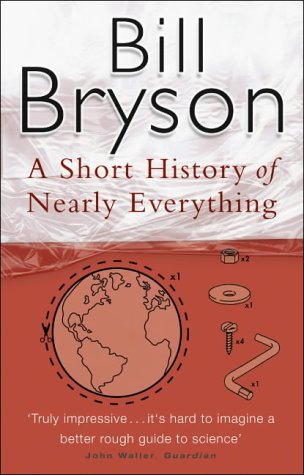
Except for the last three words ‘Pass the Salt’ the following extracts are entirely from the amazing book, ‘A Short History of Nearly Everything’ by the brilliant Bill Bryson.
‘Suppose that there was a button you could push and you could light up all the Earth-crossing asteroids larger than 10 metres across, there would be over a hundred million of these objects in the sky.’ In short, you would see not a couple of thousand twinkling stars, but millions upon millions upon millions of nearer, randomly moving objects – ‘all of which are capable of colliding with the Earth. It would be deeply unnerving.’
Well, be unnerved, because it is there. We just can’t see it.
Although it’s only a guess based on the cratering rates on the moon, some two thousand asteroids big enough to imperil civilized existence regularly cross our orbit. A meteor the size of a house could destroy a city and the number of these relative tiddlers in Earth-crossing orbits is almost certainly in the hundreds of thousands and possibly in the millions, and they are nearly impossible to track.
The first one wasn’t spotted until 1991, and that was when it had already gone by. Named 1991BA, it was noticed as it sailed past us at a distance of 170 000 kilometres – in cosmic terms the equivalent of a bullet passing through one’s sleeve without touching the arm. Two years later, another, somewhat larger asteroid missed us by 145 000 kilometres – the closest pass yet recorded and it too was not seen until it had passed and would have arrived without warning.
An object a hundred metres across couldn’t be picked up by any Earth-based telescope until it was within just a few days of us, and that is only if a telescope happened to be trained on it. This is unlikely because the number of people in the world actively searching for asteroids is not much more than the staff of a typical McDonalds restaurant. The first time an unnoticed asteroid would become visible to the naked eye would be when it warmed up when hitting the atmosphere, just about a second before it hit the Earth. You’re talking about something moving many times faster than the fastest bullet.
Here’s a plausible scenario of what it may/will be like if we have an impact of a big asteroid.
a) An asteroid travelling at cosmic speeds entering the Earth’s atmosphere would compress the air causing it to rise to some 60 000 Kelvin or ten times the surface temperature of the sun. At this instant of arrival, everything in the meteor’s path – people, houses, factories cars would crinkle like cellophane in a flame.
b) On impact, the meteorite would vaporize instantly and the blast would blow out 1 000 cubic kilometres of rock, earth and superheated gases. Every living thing that hadn’t been killed by the heat with a range of 250 kilometres would now be killed by the blast.
c) The initial shock wave would travel outwards at the speed of light sweeping everything before it. Within minutes in a surrounding area the size of Northern Europe every standing thing would be flattened or on fire. People up to 1 500 kilometres away would be knocked off their feet and showered with a blizzard of projectiles.
d) The associated damage would be brisk and global. The impact would set off a chain of devastating earthquakes, volcanoes, tsanumis. Within an hour, a cloud of darkness would cover the Earth, burning rock pelting down everywhere setting much of the planet ablaze.
e) It has been estimated that at least one and a half billion people would die by the end of the first day.
And in all likelihood, remember, this would come without warning, out of a clear sky.
– Pass the salt!
 A Monkey in Manhattan