A Monkey in Manhattan
This ape's thinking has evolved sufficiently to know that this is all there is.
You can scroll the shelf using ← and → keys
You can scroll the shelf using ← and → keys
Eritis sicut Deus, scientes bonum et malum
In the day ye eat thereof, then your eyes shall be opened, and ye shall be as gods, knowing good and evil’
I’ve been researching war records for background information for a character for a book. I’m interested in the feared Japanese invasion of Calcutta in 1942 after they had taken Burma, Thailand and routed the British forces to seize control of Singapore. The then British Raj is in its last throes. The Indian Nationalist voice, ‘Quit India’ is becoming more powerful exacerbating the difficulties in fighting the war in Europe, North Africa and the Pacific.
So…who is the Governor of Bengal at this time? – Read on!
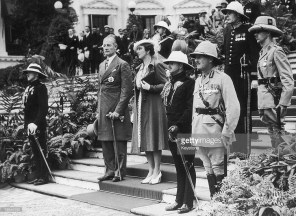
John Arthur Herbert is the son of a diplomat and an american emigrant. The First World War abruptly cuts short his education and he enlists into the Royal Horse Guards. A year later, he is commissioned as a temporary second lieutenant which becomes a second lieutenant and then a lieutenant in ‘the Blues’. After hostilities ends, the household cavalry is reorganized and permanently stationed in London throughout the inter-war period. Herbert is made a captain.
He marries into aristocracy. His bride is 21 year old Lady Mary Theresa Fox-Strangways. Several hundred invited guests hold up the Kensington traffic along the Brompton road as far as Harrods at their wedding The reception, held at Holland House which has been owned by the Fox family for the last 200 years and handed down to Lady Mary’s father, the 6th Earl of Ilchester, is a very lavish affair. Gifts for the bride include a diamond cipher and monogram brooch from the king and queen, a gold and alabaster clock from Princess Mary and Viscount Lascelles; a shagreen cigarette case from the Duke and Duchess of York and a pair of silver lamps from Princess Victoria.
Herbert follows his father as the Master of the foxhounds of the Monmouthshire pack, managing to combine the job with being Adjutant of the Blues. In 1934 he is made into a honorary Major and contests the Monmouth by-election; it has always been a safe conservative hold. Herbert duly holds on to it in the following year’s general election and during his five years at Westminster, he becomes an assistant unpaid whip. Herbert, by no stretch of any imagination, gains great experience in the affairs of state. In parliament he only makes 13 utterances, according to Hansard so it is quite a surprise to all, when it is announced, that he is to become the new Governor of Bengal in ’39 on the death of the very popular Lord Brabourne.
At this point, there is an obvious need to increase Herbert’s ‘noteworthiness’ or ‘precedence’. His rank of Major is upgraded to Colonel and he is hastily made a Knight Commander of the Indian Empire, GCIE. The award of the various orders of chivalry in these years is quite breathtaking. Herbert is comparatively a nobody but is advanced with all the nepotism that characterises British government in these (any?) days. The Indian Civil Service especially notes his appointment ruefully. According to several top ICS officers who serve under him, including one who was his private secretary, and this is putting it mildly, he is not considered having the necessary talents for the job. Herbert, by all accounts, possesses ideas that fall admirably in line with the imperial designs of the British. To add to his rather complex character, he is known as ‘Herbert the pervert’ in intimate circles for some of his strange proclivities. In governship he acts with brutally repressive measures, deploying both the police and the military who take the law in their own hands. They make few arrests. Instead they kill, burn, torture, maim and rape, all with a carte blanche issued by governor Herbert.
So in December 1942 with the Japanese bombing Calcutta and the fear that India would be invaded from the east, Churchill the instigator with the compliance of Viceroy Linlithgow and Herbert the puppet, push a scorched earth policy – which goes by the sinister name of Denial Policy – in coastal Bengal. Authorities remove boats (the lifeline of the region) and the police destroy and seize rice stocks. The consequences of these actions, in tandem with devastating floods caused by a cyclone, are cataclysmic. The Bengal Famine of 1943 is not covered in British history lessons and was wholly covered up in the years after the war. When we’re asked about the holocaust, we should ask – “Which one?”
Starving people beg for the starchy water in which rice has been boiled. Children eat leaves and vines, yam stems and grass. Parents dump their starving children into rivers and wells. Many take their lives by throwing themselves in front of trains. People are too weak even to cremate their loved ones as no one has the strength to perform the usually essential rites. Dogs and jackals feast on piles of dead bodies in Bengal’s villages. Cannibalism exists. The ones who get away are men who migrate to Calcutta for jobs and women who turn to prostitution to feed their families. Mothers turn into murderers, village belles into whores, fathers into traffickers of daughters.
The famine ends at the end of the year as soon as the military and commercial logistics, together with the will, prevail to move grain and rice stocks from other areas of India. This is initiated by the new incumbent of Viceroy, Field Marshall Wavell. It has since been established how Churchill and his associates could easily have stopped the famine but they refused, in spite of repeated appeals including the President of the United States. Government stocks are released but only to feed the people of Calcutta, especially British business people and their employees, railway and port workers and government staff. Controlled shops are opened for more important Calcuttans and the urban population never suffer too greatly. The rural masses, however, are left to the wolves.
The Bengal Famine was not caused by lack of food. Generally the estimates of the death toll are between 1.5 and 3 million, taking into account death due to starvation, malnutrition and disease.
Half of the victims died from disease after food became available in December 1943. Food production was actually higher in 1943 compared to 1941 but the British Empire took 60% of all harvests and ordered Bengal to supply a greater proportion of the food for their army to fight the Japanese. As in previous Bengal famines, the highest mortality was not in previously very poor groups, but among artisans and small traders whose income vanished when people spent all they had on food and did not employ cobblers, carpenters, etc. The famine caused major economic and social disruption, ruining millions of families for decades to follow.
Before his (un)timely death at the end of 1943 to which some high ranking ICS personnel have written, ‘good riddance’, Sir John Arthur Herbert was sanctioned by the King in promotion in and appointment to The Venerable Order of the Hospital of St John of Jerusalem. The order was founded throughout the Commonwealth of Nations, Hong Kong, the Republic of Ireland, and the United States of America,with the world-wide mission “to prevent and relieve sickness and injury, and to act to enhance the health and well-being of people anywhere in the world.”
His wife, Lady Mary was awarded the Kaisar-i-Hind gold medal (for usefulness in or for India) in 1942. Herbert’s military secretary, Lt Col Wilmot Bloomfield Peel writes in an obituary for Lady Mary, …. ‘her devotion to duty was unsparing as was the loyal and encouraging help she gave to her husband in alleviating the distress caused to the people of the province by the floods and famine, the destruction and horror of which shook the stoutest souls.’
A Commission’s report into the famine was well organised, coherent, filled with information – and utterly misleading. When the Commission had finished its considerations, the Chairman, Sir John Woodhead, ordered the destruction of all the evidence gathered. The Commission was a tremendous success. It delayed and concealed the issues involved, and, coupled with the careful press censorship enforced at the time, the whole issue of the famine was misted over and forgotten.
There is a problem with British military history, succinctly outlined by an American historian and author, Barbara Tuchman:
No nation has ever produced a military history of such verbal nobility as the British. Retreat or advance, win or lose, blunder or bravery, murderous folly or unyielding resolution, all emerge alike clothed in dignity and touched with glory. Every engagement is gallant, every battle a decisive action. There is no shrinking from superlatives: every campaign produces a general or generalship hailed as the most brilliant of the war. Everyone is splendid: soldiers are staunch, commanders cool, the fighting magnificent. Whatever the fiasco, aplomb is unbroken. Mistakes, failures, stupidities and other causes of disaster mysteriously vanish. Disasters are recorded with care and pride and become transmuted into things of beauty.
 A Monkey in Manhattan