A Monkey in Manhattan
This ape's thinking has evolved sufficiently to know that this is all there is.
You can scroll the shelf using ← and → keys
You can scroll the shelf using ← and → keys
Peter Cook was educated at St Peter’s College, Radley, a public school near Abingdon in Oxfordshire.
The following are extracts from a biography of Peter Cook by Harry Thompson.
Radley had strong links with overseas service which was why Peter had been sent there. In the words of one contemporary, Robin Gunn,’It was a very insular society, geared to producing characters of self-sufficient enough to govern the natives in distant, lonely, steamy parts of the globe.’
It goes without saying that Peter’s first year or so at Radley was utterly miserably unhappy. He intensely disliked the authority that the school exercised over him and those who applied it.
Peter’s first wife Wendy remembers that,’He did share with me how sometimes he would bang his head on the wall in despair in the night because he couldn’t breathe and I think he felt so abandoned. He really had such a lonely time.’
Peter Cook soon learnt to use humour as a form of self-defence.
‘I hated the first two years,’ he explained,’because of being bullied. And I was as cowardly as the next man, I didn’t enjoy getting beaten up and I disliked being away from home – that part was horrid. I could make fun of other people and therefore make the person who was about to bully me laugh instead.’ How many times, over the years, has the British comedy industry had cause to be grateful for generations of public school bullies.
Peter’s particular bete noire at Radley was the Senior Prefect, Ted Dexter, later to become England’s cricket captain. Even in later life, Peter was still ‘really angry’ at the treatment he had received at the hands of Dexter.
As well as having to endure the disciplinary attentions of Dexter and his sort, Peter found his pretty features attracted a different kind of unwelcome attention. Asked later by Michael Parkinson what his chief memory of Radley was, he replied: ‘Trying to avoid buggery. I’ve always wanted to look up one old acquaintance of mine – and I won’t mention his name, he’ll know perfectly well who he is, the dirty sod. I was a young quite pretty boy, number three in the charts and he was a prefect, and he came into my cubicle. I was reading a magazine and he sat on the bed and put his hand up the back of my pyjamas and started stroking my back. And he said, “Do you mind that, Cook?” And I said “Yes …” In fact I didn’t mind at all but I felt I ought to say yes, because my master had had me in at the beginning of term and had said, “As a young boy, Cook, you will discover that there are a lot of other boys at this school. And sometimes…. the other boys…..do things to the younger boys.”
Asked later by Playboy magazine how he had lost his virginity at the school, he retorted, ‘At what end?’
It fills me with immense pride to have been a state school teacher all my life. Peter Cook’s experiences are of course not thankfully universal but a good friend of mine who is a counsellor once told me that a statistically significant disproportionate number of his clients are from private boarding schools. We have had two fantastically talented boys from our school win scholarships to Eton in recent years and I’m absolutely certain that today’s improved culture serves to protect them from the customs and abuse that boys used to suffer. When invited to join in the acclaim that these public fellowships bring to the school, I become a silent conscientious objector. You see, in state schools, we teach anybody and everybody. We often find our most valued role is helping young people cope, at such an impressionable age, with all the things that Peter Cook was coming to terms with. We don’t fuck them up or indeed try to fuck them!
John Cleese, in a posthumous assessment, distilled the essence of Cook’s talent:
“Most of us have to grind away for something like six or seven hours – that’s what Chapman and I used to reckon – to produce three minutes of material, whereas for the first fifteen or twenty years of Peter’s professional life it took him exactly three minutes to produce three minutes of material …..”
Professionals will tell you that literally holding up a mirror to some people with poor self-esteem has been a good technique to encourage them to view themselves in a more favourable light.
In this song, Jake Bugg sings to a girl that she must stop being so hard on herself and realise how beautiful she really is, by writing a note to self.
Simplicity is genius. How can somebody so young, encapsulate something so succinctly, that there is no blame, it’s not your fault and try not to be your own worst enemy.
Hollywood exaggerates to gain the greatest impact and historic traumatic episodes aren’t resolved completely in a morning but this scene from ‘Good Will Hunting’ serves to make this point.

Whenever you see a big number ending in zeros, it’s very probable that the number has been rounded. It could be on the basis that the receiver either doesn’t need to know the exact value, (it’s not important) or the informant doesn’t know what the actual number is.
In the following example, a football attendance, let’s say, has been given to varying levels of accuracy, said to be rounding to a specified number of significant figures.
76 537 = 80 000 (to 1 s.f.)
= 77 000 (to 2 s.f.)
= 76 500 (to 3 s.f.)
The number of British troop deaths, at the time of writing, has reached 446. No zeros there and understandably so. We care what the actual number is and the relative low size makes it still possible to individualise each member of the set.
In contrast, I have heard many times, even opponents of the war in Iraq, refer to the 100, 000 Iraqi civilian deaths there have been as a consequence of the illegal war. The magnitude of this number seems to be undisputed but do you see the use of the zeros. Is it because we don’t know the actual truth or simply we don’t care? I honestly don’t know but there’s good news for if you visit the Iraq Body Count website one can access a far more accurate figure.
The concept of big numbers is a difficult one for young children to grasp. If you counted a million pounds, one pound every second, it would take over 12 days and nights to do it. It’s a really humongous number. Ask the Great Train Robbers of 1963 who hadn’t planned into their schedule the time involved to count their booty! The relative size of a million, billion and trillion are beautifully demonstrated by this film called, ‘What does a trillion dollars look like?’
Think about it. It would need 44 000 articulated trucks to take 1 000 000 000 000 real dollars to the bank. The truth is that it’s not and never will be real. I doubt if such an amount has ever been printed in the history of the world. Capitalism knows no limit and my fear is that many people don’t realise the immensity of such illusory ‘monopoly’ numbers, like the UK National Debt
Journalists know that 1 000 000 people killed is a statistic whereas one person’s plight is a story.
So History teachers, how about this way of getting over how many Jews were killed in the holocaust. 6 000 000 is the statistic that everyone knows, lots of zeros there, mind, remember our two rules?
I took a Year 7 class into our Drama hall and by lying head to toe, we estimated that we could fill the hall, sardine-like by 25 x 20 x 12 (= 6 000) bodies. The bowl volume of Wembley stadium is 1.1 million cubic metres which is conveniently about 1 000 times the size of our hall, …trust me I’m a Maths teacher!
Now what this means is that if you filled Wembley stadium, sardine-wise, with bodies to the top, that’s how many Jews were killed in the extermination camps. The slightly smaller Millenium stadium in Cardiff should be big enough to carry the slightly less important
2 – 3 000 000 Soviet POWs
1.8 – 2 000 000 Ethnic Poles
220 000 – 1 500 000 Romani (interesting range!)
200 000 – 250 000 Disabled
90 000 Freemasons, Homosexuals, Jehovah’s Witnesses
Anyway, do you see that steward in the florescent jacket in the foreground for scale? (Click on picture to enlarge)
Geddit! – Is that significant enough for you?

“What’s that Danny! – there’s a puppy in the playground?
Have you been listening to a damn thing I’ve been saying, boy?
Ok, chairs under, off you go.”
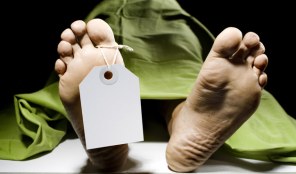
I found my elderly neighbour dead in his living-room this morning. When I say I found him, that’s not entirely true because it was Warren who had ten minutes previously discovered Robin and had rung our doorbell to use the phone. Warren seemed in shock so I very sensitively volunteered to take over and deal with the situation. The emergency services wanted me to go into Robin’s flat, phone them from there to confirm some details. So this is exactly how I found myself for the first time in my 56 years on this earth face to face with a human corpse. For those who have been to many a wake or worked with the elderly, fatally injured in accidents or terminally ill in hospital are justifiably entitled to think, you’ve led a sheltered life, welcome to my world!
Robin had probably died the night before whilst recovering from a long stressful car journey returning from spending Christmas with his son. It looked like he was getting ready for bed when he suffered a fatal heart attack. He was partially undressed, his face had turned purplish blue, his eyes were wide open and the indignity of his position for such a proud bon-viveur gentleman was what struck me most. Except for those first dutiful inspections of Robin’s corpse, I found it hard to look in his direction while I waited for the ambulance service to arrive. My emotions were of no great sadness, upset or physical queasiness (Robin had survived cancer surgery and endured severe respiratory and heart problems) just enormous respect and reverence to be present at an extinguished life. I have to admit that in sensitively volunteering to witnessing Robin’s demise, I had probably seized an opportunity to finally confront such an ordeal.
The paramedics took over and they with the police went through all the procedural paperwork and protocol with their usual considerable professional efficiency. Warren was questioned for the details needed. I made tea and my thoughts, rather less selflessly, turned increasingly to the afternoon’s football programme, as my use and need to the proceedings diminished.
You see when I was in my early twenties, I witnessed my own father’s gradual and painful demise over a difficult month but missed the merciful final passing. I only have had the memory of the frenzied panic as he grasped the oxygen mask to steal a breath that his lungs couldn’t manage to supply and that orange liquid that I felt obliged to encourage him to take that the medical staff briefed us was the only sustenance his body would not fully reject. Even the psoriasis that had blighted him all his life had departed his skull and joints, no longer being able to be hosted by his skeletal frame.
I expect no more of others who will later find me. Cart me off and waste no further time in getting on with the rest of your remaining days. I have after all, like Robin, had a great life for which I’m grateful.
<a

Some years ago, I found myself in rural India, visiting newly-formed schools, 200km north-east inland from Calcutta. A long train journey followed by a invariably uncomfortable jeep drive took me past increasingly smaller settlements.The last dry, dusty rutted road we travelled along would have been impassable by any driver other than our well-initiated host. Over the next week or so, I met beautiful wonderful and essentially grateful people who had experienced very little or no contact with the outside world and who were absolutely delighted to greet us. Adjectives ending in -ful are fitting words to use as your lasting impression is that these humble people live such full rich lives and still uphold values that we have sadly lost.
Usually in these circumstances, whilst being overwhelmed by the hospitality, warmth of welcome and the garlands, it is easy to just take pictures and not reflect enough on the incredible significance to one’s thinking about your own life. If there was very little sign of seepage of laudable western civilisation’s influences, there was refreshingly less evidence that the worst traits had reached this hinterland. From my Jeep’s window, I observed the commonplace use of shadoofs in the fields for irrigation. I remember learning at school how the ancient Egyptians had used these primitive levers to water their crops. The question I posed myself was if I was in an extensively farming area where working practices have not changed appreciably in thousands of years, then I shouldn’t be surprised if ideas, attitudes,beliefs and lifestyles haven’t evolved accordingly. Civilisation used to be laid down in incredibly thin veils, I think of this when I come across such provisions as statutory wheelchair access and surrogate teaching assistants for pupils with learning difficulties. You won’t be surprised to learn that I didn’t see any evidence of these luxurious amendments. It takes time for these changes to take place, millennium, centuries or as little as decades if you’re an awakening giant like China or if you’ve had occupying colonialists leave to free up the process.
On the night of our arrival, one of my fellow travellers pointed to a faraway hut from our hostel balcony and suggested we might walk there to have a beer.Taking into account that our evening meal was cooked on a wooden fire and the only drink available was water because only the essentials to life are in use, I doubted the profit would accrue from such a walk.
“There’s nothing of luxury value in that hut, Chris. Do you know why? – because there’s nothing coming up that bleedin’ road. No non-essential goods, no people, no ideas, no influences. If there were, that hut would changed into a hovel over time which would have progressed into a shack, which in turn would have evolved into a house. We would be looking at a Manhattan skyline but we’re not!”
To build a road means to connect people to the outside and time does the rest. Be careful though to have a checkpoint so as to not let in those veils that cause you to lose what is important to preserve.



 A Monkey in Manhattan