A Monkey in Manhattan
This ape's thinking has evolved sufficiently to know that this is all there is.
You can scroll the shelf using ← and → keys
You can scroll the shelf using ← and → keys

My chemistry teacher told me at school, to demonstrate the size of a molecule, that if you take a beaker of water from the oceans of the world, count the molecules therein and then replace the water and take a second beaker, there will be 20 000 molecules that were in the first beaker that could also have been in the second beaker. This is to say that, there are 20 000 more molecules in a beaker of water than beaker of waters in all the oceans of the world. That’s how small a molecule is!
Now, as a teenager, I couldn’t help but think, what if you were to take the first beaker of water off , let’s say, Japan and the second off Newfoundland! Literally speaking, surely there would be no overlap of contents, I was of course completely missing the point but all the same I’ve got you there haven’t I Sir? – Well, not necessarlily so. The beaker metaphor depends on you understanding that it illustrates the numerical comparison between the two quantities and you need to realise it is a comparison between the pure probability of each event happening. That is, that each molecule has a equal chance of being in both beakers, if you like, that the oceans have been vigorously ‘stirred’ and a sufficient amount of time has been left for free movement.
Imagine my literal delight/surprise to learn 40 years later the following:
The atmosphere is very dynamic. Oxygen, Nitrogen, even carbon particulates are very quickly homogeneously distributed throughout the biosphere. In a book by Harlow Shapley, “Beyond the Observatory”, the journeys of the inert gas argon are outlined. Apparently, we take in like 3×10^19 atoms in every breath, and in one week these atoms are already distributed throughout the country! A very famous example of the recycling of atoms is this. Every breath that you take, there is about a 100% chance that you will inhale at least one air molecule that was exhaled by Julius Caesar in his dying breath. In Bill Bryson’s book, ‘The Short History of Nearly Everything’ he writes that each of us share atoms that once made up Shakespeare but of course this could be any historical figure if enough time has passed to make statistical sampling unbiased.
It’s interesting that Shakespeare is used as an example of a notion for he himself (or more likely Edward de Vere) contemplated this concept in Hamlet:
Hamlet: (Examining Yorick’s scull) Dost thou think Alexander lookt o’ this fashion i’ th’earth? Horatio: E’en so.
Hamlet: And smelt so? Pah! [puts down the scull]
Horatio: E’en so my lord.
Hamlet: To what base uses we may return, Horatio! Why may not imagination trace the noble dust of Alexander till he find it stopping a bung hole?
Horatio: ‘Twere to consider too curiously, to consider so.
Hamlet: No, faith, not a jot; but to follow him thither with modesty enough, and likelihood to lead to it; as thus; Alexander died, Alexander was buried, Alexander returneth into dust; the dust is the earth; of earth we make loam; and why of that loam whereto he was converted might they not stop a beer-barrel?
Imperious Caesar, dead and turned to clay,
Might stop a hole to keep the wind away:
O, that the earth that kept the world in awe
Should patch a wall t’expel the winter’s flaw!
This view, would lead to describe oneself as a temporary collection of assorted atoms that have been re-cycled from other objects and are currently assembled in such a way as to create a sentient entity,
The atoms that currently form me will have all come from something else. Some may have previously been in the rocks of Mount Everest, or perhaps they were sea water, a giant redwood tree, oxygen in the atmosphere, or the soil under our feet. They could have come from just about anything, even from other planets. Some of my atoms will previously have been part of another person many years ago, and after my death, given enough decades to fully re-circulate, will again form part of someone else, and also something else. All over the planet, since it was created, atoms have been busily re-cycling from one form to another; at times being part of inanimate objects and other times being part of a living thing, be it plant or animal or human. In a strange and paradoxical way we are both temporary and eternal, nothing and everything, thanks to our atoms.
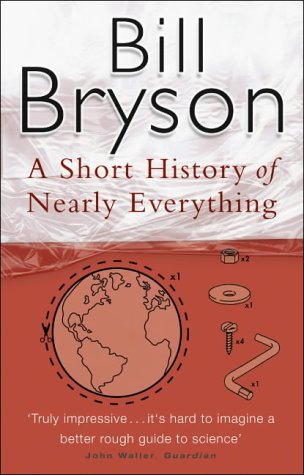
The following extracts are entirely from the amazing book, ‘A Short History of Nearly Everything’ by the brilliant Bill Bryson.
If you’d like to make a Big Bang universe, you need to gather up everything there is – every last mote and particle of matter between here and the edge of creation – and squeeze it into a spot so infinitesimally compact that it has no dimensions at all. This is known as a singularity.
Now get ready for a really big bang! You may wish to retire to a safe space to observe the spectacle but unfortunately there is nowhere to retire to because outside the singularity there is no where. It is natural to think of the singularity as a pregnant dot in a vast, boundless void but there is no space for it to occupy, no place for it to be. We can’t even ask how long it has been there, whether it has been there for ever, quietly awaiting the right moment. Time doesn’t exist; there is no past for it to emerge from.
And so from nothing our universe begins.
When this happened is a matter of debate, the consensus seems to be heading for about 13.7 billion years ago when there came a moment known to science as t = 0.
13 700 000 000 years ago
In a single blinding pulse, a moment of glory much too swift and expansive for any form of words, the singularity assumes heavenly dimensions, space beyond conception.
One ten million trillion trillion trillionth of a second, after the moment of creation, the universe is so small that you would need a microscope to find it.
0. 000 000 000 000 000 000 000 000 000 000 000 000 000 000 1 secs
But then according to inflation theory, the universe underwent a dramatic expansion. Every 10 -34 of that first second, it doubles its size changing it from something you could hold in your hand to something at least 10 million million million million times bigger.
In less than a minute the universe is a million billion miles across and growing fast.
1 000 000 000 000 000 miles across
There is a lot of heat now, about 10 billion degrees of it, enough of it to begin the nuclear reactions that create the elements of hydrogen, helium and lithium. 98% of all matter has been produced and it was all done in about the time it takes to make a sandwich.
Such quantities are of course ungraspable. It is enough to know to know that in a cracking instant we were endowed with a universe that was vast – at least a hundred billion light years across but possibly any size up to infinite – and perfectly arrayed for the creation of stars, galaxies and other complex systems.
100 000 000 000 000 light years
For mankind, the universe goes only as far as light has travelled in the billions of years since the universe was formed. This visible universe – the universe we know and can talk about – is a million million million million miles across.
1000 000 000 000 000 000 000 000 miles across
But according to most theories the universe is much roomier still. The number of light years to the edge of this larger unseen universe would be written not with tens of zeros, not even with hundreds but with millions.
Astronomers these days can do the most amazing things. If someone stuck a match on the moon, they could spot the flare. From the tiniest throbs and wobbles of distant stars, they can infer the size, character and habitability of planets much too remote to be seen – planets so distant that it would take us half a million years in a spaceship to get there.
With their radio telescopes they can capture wisps of radiation so preposterously faint that the total amount of energy collected from outside the solar system by all of them since collecting began (in 1951) is ‘less than the energy of a single snowflake striking the ground.’ (Carl Sagan)
As for our own solar system, none of the maps you would have seen was drawn remotely to scale. It is a necessary deceit to get them all on the same piece of paper.
On a diagram drawn to scale with the Earth reduced to the size of a pea, Jupiter would be about 300 metres away and Pluto would be 2½ kilometers distant (and about the size of a bacterium, so you wouldn’t be able to see it anyway). On the same scale, Proxima Centauri, our nearest star, would be 16 000 kilometres away. Even if you shrank everything down so that Jupiter was as small as the full stop at the end of this sentence, and Pluto was no bigger than a molecule, Pluto would still be over 10 metres away.
The number of probable planets in the universe is as many as ten billion trillion – a number vastly beyond imagining. But what is equally beyond imagining is the amount of space through which they are lightly scattered. If we were randomly inserted into the universe, the chance that you would be on or near a planet would be less than 1 in a billion trillion trillion.
0. 000 000 000 000 000 000 000 000 000 000 001 chance
‘Worlds are precious’
The average distance between stars is over 30 million million kilometres. Even at speeds approaching those of light, these are fantastically challenging distances for any traveling individual. Of course, it is possible that alien beings travel billions of miles to amuse themselves by planting crop circles in Wiltshire or frightening the daylights out of some poor guy in a pickup on a lonely road in Arizona but it does seem unlikely.
A supernova occurs when a giant star bigger than our sun collapses and then spectacularly explodes, releasing in an instant the energy of a hundred billion suns. Most are so far away that they appear no more than the faintest twinkle, occupying a point in space that wasn’t filled before.
Looking for supernovae is mostly a matter of not finding them! Telescopes can now take pictures and let computers detect the telltale bright spots that marked a supernova explosion, but before this technology it was down to the human eye and countless hours of staring at the sky.
The Reverend Bob Evans from Sydney, Australia does this better than anybody else who has tried to spot these moments of celestial farewell.
To understand how good he is, imagine a standard dining-room table covered in a black tablecloth and throwing a handful of salt across it. The scattered grains can be thought of as a galaxy. Now imagine 1 500 more tables like the first one – enough to make a single line 2 miles long – each with a random array of salt across it. Now add one grain of salt to any table and let Bob Evans walk among them. At a glance he will spot it. That grain of salt is the supernova.
…and he has done it 33 times, beating NASA everytime!
Fantastic ending to a brilliant voyage of discovery film.
‘I have neither the time nor the inclination to explain myself…………. and then questions the manner in which I provide it…………I would rather you just said thank-you and went on your way’
Very low key story of an old man travelling by his lawnmower to see his brother for the last time.
Charlie Chaplin’s final speech in the film the great dictator, with a splash of modern imagery. Song: Window by The Album Leaf
At the end of the war, Itzhak (Ben Kingsley) presents Oskar (Liam Neeson) a gold ring with the inscription “whoever saves one life, save the world entire.”
Great ending to a great film.
Classic Jack Nicholson moment
Pure evil. So brilliantly acted that it’s hard to believe they’re actors. It’s terrible to think that with millions of jews being transported to the extermination camps, this scene was real for many poor souls.
“I ain’t no white trash piece of shit, I’m better than you all. I can outlearn you, I can outread you, I can outthink you and I can outphilosophise you. And I’m gonna outlast you. You think a couple of whacks to my good old board is just gonna get me down? It’s gonna take a helluva lot more than that counsellor to prove that you’re better than me..”
Inspirational film for two reasons for me. Firstly, interesting concept for anybody to contemplate on; what difference would it have made if I hadn’t been born. How much positively do I contribute and if the answer is little, stop your complaining about others. Secondly, the astonishing zeal that James Stewart portrays when he’s telling Mary how he’s going to change the world.
Wordplay sketch based on an Oscar Wilde quote about the few things in life that can be said to be really unique.
Best bit of Lee Mack’s fist DVD.
Rob Brydon and Steve Coogan Impressions on The Trip
Fantastic collection of clips of history routines from Dressed to Kill
Stephen Fry and Hugh Laurie in a example of their linguistically clever and funny sketches.
Baldrick helps Blackadder rewrite the entire English dictionary before Doctor Johnson returns. But they’re not getting very far.
Ricky Gervais as ‘Doctor Ben’ in American television series ‘Louie’.
Lauren gets worked up over her French exam. Another hilarious moment from Catherine Tate’s BBC comedy sketch show.
Pure genius of character formation, writing and performance.
Frightingly too true to be funny. This is how it used to be! An important public service announcement brought to you by the comedy legend Harry Enfield and his Chums.
Mighty Boosh doing serious Russian drama.
Super ‘Slow-Mo’ 1200 frames a second of a cheetah’s running action.
This video was shot by Jon Rawlinson. The music is “Please don’t go” by Barcelona.
The main tank called the ‘Kuroshio Sea’ holds 7,500-cubic meters (1,981,290 gallons) of water and features the world’s second largest acrylic glass panel, measuring 8.2 meters by 22.5 meters with a thickness of 60 centimeters. Whale sharks and manta rays are kept amongst many other fish species in the main tank.
Roger Hanlon, senior scientist at the Marine Biological Laboratory in Woods Hole, studies camouflage in cephalopods–squid, cuttlefish and octopus. They are masters of optical illusion.
Many birds adapt to metropolitan life, in this clip you can see how crows in Japan have integrated city life into their behaviour. From the BBC
A red fox pinpoints field mice buried deep beneath the snow, using his sensitive hearing and the magnetic field of the North Pole to plot his trajectory.
A strange relationship between dogs and bears.
Taken from the show “Jailed Polar Bear” on FirstScience.tv
Spouse Shop
A store that sells new husbands has opened in New York City , where a
woman may go to choose a husband. A woman goes to the Husband Store to find a husband.
On the first floor the sign on the door reads:
Floor 1 – These men have jobs
She is intrigued, but continues to the second floor, where the sign reads:
Floor 2 – These men have jobs and love kids.
‘That’s nice,’ she thinks, ‘but I want more.’
So she continues upward. The third floor sign reads:
Floor 3 – These men have jobs, love kids, and are extremely good looking. ‘Wow,’ she thinks, but feels compelled to keep going.
She goes to the fourth floor and the sign reads:
Floor 4 – These men have jobs, love kids, are drop-dead good looking and help with housework. ‘Oh, mercy me!’ she exclaims, ‘I can hardly stand it!’
Still, she goes to the fifth floor and the sign reads:
Floor 5 – These men have jobs, love kids, are drop-dead gorgeous, help
with housework, and have a strong romantic streak.
She is so tempted to stay, but she goes to the sixth floor, where the
sign reads:
Floor 6 – You are visitor 31,456,012 to this floor. There are no men on
this floor. This floor exists solely as proof that women are impossible
to please.. Thank you for shopping at the Husband Store.
PLEASE NOTE:
To avoid gender bias charges, the store’s owner opened a New Wives store just across the street.
The first floor has wives that love sex.
The second floor has wives that love sex & have money & like beer.
The third, fourth, fifth and sixth floors have never been visited.
 A Monkey in Manhattan