A Monkey in Manhattan
This ape's thinking has evolved sufficiently to know that this is all there is.
You can scroll the shelf using ← and → keys
You can scroll the shelf using ← and → keys

The astonishing aspect of Edward Snowden’s whistle-blowing is the absolute bravery and sacrifice of this young man for the common good. This is even more extraordinary if you think that he did all this despite knowing that his actions would inevitably lead him to be punished mercilessly whilst being branded a traitor. We must not allow it!
Governments, the law, the intelligence network and corporations are not serving us. All of our traditional institutional regulatory bodies are routinely bypassed and in fact complicit. Investigative journalism gives us hope and is doing what these agencies, often illegally, are failing to deliver. However, understandably and legitimately, that’s where the hack’s role has to stop and it’s now really up to all of us folks to take back control!
All wars are economic. One easy way to fight this frightening trend towards the attack on freedom and democracy is to immediately stop buying Apple phones, Exxon and Esso oil, to close your bank account with Lloyds Bank and JPMorgan Chase and don’t buy anything off Amazon, GlaxoSmithKline or that’s manufactured by General Electric. That should just about do it overnight. The second thing we could do is to vote, in numbers and intention, like we have never done before to give the clearest message ever given by an electorate. Don’t put your cross next to the blue or the red team but simply spoil your ballot paper – i.e. ‘None of the above’ – In other words, we want you to …’Think again and come back to us with a better set of ideas and values’
‘The way they control us is to frighten us all the time. They frighten you, they divide you; men and women, black and white, christian, muslim, jew. Then they demoralise you – you don’t understand and they make you cynical, everybody’s a crook.
If you want to win, you mustn’t be frightened, you mustn’t be divided, you mustn’t be demoralised and you mustn’t be cynical. And once people discover that, then it’s astonishing what can be achieved.’
Tony Benn
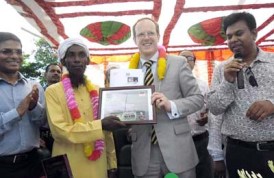
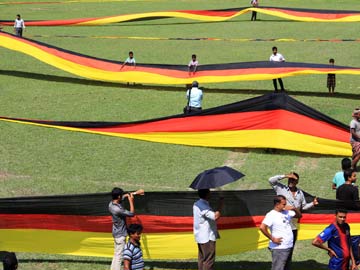
Germany has honoured a Bangladesh farmer and diehard fan for making a 3.5-kilometre-long (2.2 mile) flag of the country in support of Philipp Lahm’s World Cup team, officials said on Sunday.
The massive flag was on display Saturday at a stadium in the western town of Magura, which the German charge d’affaires, Ferdinand von Weyhe, visited to pay tribute to the farmer.
“The 3.5-kilometre-long German flag circled the stadium four times and hundreds of people have turned up to see this amazing sight,” said Ishrat Hossain, a German embassy spokeswoman.
She said Von Weyhe handed the farmer, 65-year-old Amjad Hossain, a life membership of the official fan club of the German national team, a football, a team jersey and a certificate of appreciation.
The farmer told AFP he became a German fan out of gratitude after he recovered from a gallbladder stone by taking homeopathic medicine made in Germany.
“I started making the flag after the 2006 World Cup in Germany. It was extended in the 2010 World Cup and in this World Cup I added more cloth. It’s now 3.5 kilometre long,” Hossain said
Hossain, an impoverished farmer, said he sold a piece of farmland to help pay for the flag which cost 240,000 taka ($3,000).
“The flag will be a success if Germany win the World Cup,” he said.
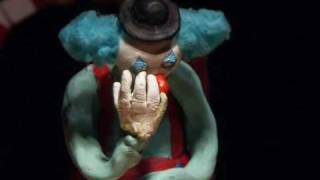
I found this poem when I was training to teach in the 70’s and used it with various age groups. I used it as an example of empathy – because that’s what I think it’s about. That’s the beauty of art in all its forms, it means different things to different people. I can’t stand being told what I’m supposed to think or feel about a painting, film or piece of music.
I found an literary appraisal of Cloony the Clown on a forum, indicating the lines where alliteration, anaphora, hyperbole and consonance had be used. I prefer to think ‘simplicity is genius’ and it isn’t really necessary to de-construct a flower.
Shel Silverstein
“Slight was the thing I bought,
Small was the debt I thought,
Poor was the loan at best –
God! but the interest!”
Paul Laurence Dunbar
You might have noticed just recently how hard it is to get a phone number on big corporation’s websites like Sky or BT. They hide it very well, preferring you to fix your own problems by way of a online chat or e-mail or some other way of registering your complaint or query. Call centres are undoubtedly expensive, it means humans have to be employed and that’s an expense the shareholders could have. If you are old or uninitiated in the ways of the computer, you have become disconnected from your provider, and they seemed so nice and friendly in the advert!
Government as a rule does not interfere with business. The food industry has been poisoning us for years but regulating them would mean lower profits and where would the first cuts be – jobs of course. The betting industry is now rampant and whose interest really does that serve? I can only think the lobbyists are lining the politicians’ pockets handsomely to let these mobsters try and squeeze every hard-earned penny out of a working man’s pay packet before it even gets home. Unless there is a popular campaign that government think might attract a few votes, even the most unethical business practice continues unabated. What’s that you say Starbucks, Google et al haven’t paid anywhere near the tax they should have in this country well I think you’ll find, like Jimmy Carr, they haven’t actually done anything contrary to the letter of the law. The spirit of the law, now that’s a different thing.
We don’t have a car, motorcycle or ship-building industry in this country any more but we are damn good at financial services. Have you ever been financially serviced!? I have banked with Lloyds for over 40 years, I should change but untying yourself from all the administrative tentacles is time consuming and prevents you doing it and they know it. Do you think that loyalty is somehow repaid – No way. It’s naive to think nowadays that any customer loyalty exists at all other than the knowledge that you’re more likely to come back in the future than some other smuck. I wanted to borrow about £3000 just recently. Lloyds don’t do loans for under £1000, there’s the reason why QuickQuid, Wonga etc exist. For loans between £1000 and £4000 the APR is 20%, for loans between £5000 and £7000 it decreases to about 10% and then settles to 6.4% for £7500+. I think that’s disgusting that our banks which are supposed to serve us solely exist to encourage us to borrow more and even penalise us for settling early. So I turn to the great offers to be had from Credit card loans at the moment – 0% for 18 months. It’s a brilliant way of getting a short term loan for virtually nothing but you have to remain vigilant. Look how hard they make it to change your payment per month. Remember you only pay interest if you don’t pay a minimum amount or if circumstances dictate you go over the duration of the 0% offer.
I am trying to open an online credit card account which might help me regulate the terms of the loan.
Firstly, I have a 10 digit ID number which you can’t change.
(OK admittedly the computer can remember it by checking box)
Press continue
I have a unique image (elephant) and phrase combination (Bizarre) to choose. It will be shown on this page to indicate that I am on the genuine Online Banking site. This is set up by me along with the 3 security questions:
Where were you born?
What was the name of your first school?
What is your mother’s middle name? All three chosen from a choice of 6/7
Next I have to enter the 6th 9th and 3rd characters of my password sent in Letter 1 of the login details, That’ll be 84381329
and then…. the 4th 2nd and 5th numbers of the 5 digit security number sent in Letter 2 of the Login details. That’ll be 16354
Give up yet?
Then I’m compelled to change the supplied password and security number to one of my choice. The restrictions on what the password and security number are unusually tough.
I’m through at last. I choose Set up/amend direct debit
It seems to be easy until I learn that all amendments to my account will only be sanctioned if I relay a 3 digit number which has been sent to me by text. (the text was sent the next day without any 3 digit number included!) I comply only to find the online programme goes on to refuse many times my request to either increase my direct debit monthly amount or let me pay off the full balance. My fustration and this deliberate avoidance is not a one-off, hence this rant!
I take to ringing now. On the 28th of March, I pass through the usual several menus of the telephone call centre exchange. My first minimum payment of £6.75 went through on 25th March and I want now to increase it considerably to say £250!. In other words I want to do what they don’t want me to do and that is to firstly pay way over the minimum payment so as to definitely not incur interest on the sum I owe and furthermore make sure I give myself every chance to pay off my debt early.
I ask if I can pay off the entire balance, an option clearly given on the online account. No comes back the answer, you must contact your bank to do that.
Can I increase my payment to £250 then – Yes you can but that will only come into operation on the 25th May!! So much for instant access and being able to have instant effect on my financial affairs. Them are the rules and we know why they’re like that don’t we?
I know I must expect pain if I want to benefit from a 0% offer, but I can afford to take on the big banks and corporations in terms of money, time and technology know-how. What about those who can’t and hence will pay over the odds? The financial service brigade know what they’re doing in playing the big numbers probability game. That is to sting that inevitable proportion of clients who they know will be either too busy/confused or not as determined as I will be to keep an eye on what is happening. – Bastards!

My chemistry teacher told me at school, to demonstrate the size of a molecule, that if you take a beaker of water from the oceans of the world, count the molecules therein and then replace the water and take a second beaker, there will be 20 000 molecules that were in the first beaker that could also have been in the second beaker. This is to say that, there are 20 000 more molecules in a beaker of water than beaker of waters in all the oceans of the world. That’s how small a molecule is!
Now, as a teenager, I couldn’t help but think, what if you were to take the first beaker of water off , let’s say, Japan and the second off Newfoundland! Literally speaking, surely there would be no overlap of contents, I was of course completely missing the point but all the same I’ve got you there haven’t I Sir? – Well, not necessarlily so. The beaker metaphor depends on you understanding that it illustrates the numerical comparison between the two quantities and you need to realise it is a comparison between the pure probability of each event happening. That is, that each molecule has a equal chance of being in both beakers, if you like, that the oceans have been vigorously ‘stirred’ and a sufficient amount of time has been left for free movement.
Imagine my literal delight/surprise to learn 40 years later the following:
The atmosphere is very dynamic. Oxygen, Nitrogen, even carbon particulates are very quickly homogeneously distributed throughout the biosphere. In a book by Harlow Shapley, “Beyond the Observatory”, the journeys of the inert gas argon are outlined. Apparently, we take in like 3×10^19 atoms in every breath, and in one week these atoms are already distributed throughout the country! A very famous example of the recycling of atoms is this. Every breath that you take, there is about a 100% chance that you will inhale at least one air molecule that was exhaled by Julius Caesar in his dying breath. In Bill Bryson’s book, ‘The Short History of Nearly Everything’ he writes that each of us share atoms that once made up Shakespeare but of course this could be any historical figure if enough time has passed to make statistical sampling unbiased.
It’s interesting that Shakespeare is used as an example of a notion for he himself (or more likely Edward de Vere) contemplated this concept in Hamlet:
Hamlet: (Examining Yorick’s scull) Dost thou think Alexander lookt o’ this fashion i’ th’earth? Horatio: E’en so.
Hamlet: And smelt so? Pah! [puts down the scull]
Horatio: E’en so my lord.
Hamlet: To what base uses we may return, Horatio! Why may not imagination trace the noble dust of Alexander till he find it stopping a bung hole?
Horatio: ‘Twere to consider too curiously, to consider so.
Hamlet: No, faith, not a jot; but to follow him thither with modesty enough, and likelihood to lead to it; as thus; Alexander died, Alexander was buried, Alexander returneth into dust; the dust is the earth; of earth we make loam; and why of that loam whereto he was converted might they not stop a beer-barrel?
Imperious Caesar, dead and turned to clay,
Might stop a hole to keep the wind away:
O, that the earth that kept the world in awe
Should patch a wall t’expel the winter’s flaw!
This view, would lead to describe oneself as a temporary collection of assorted atoms that have been re-cycled from other objects and are currently assembled in such a way as to create a sentient entity,
The atoms that currently form me will have all come from something else. Some may have previously been in the rocks of Mount Everest, or perhaps they were sea water, a giant redwood tree, oxygen in the atmosphere, or the soil under our feet. They could have come from just about anything, even from other planets. Some of my atoms will previously have been part of another person many years ago, and after my death, given enough decades to fully re-circulate, will again form part of someone else, and also something else. All over the planet, since it was created, atoms have been busily re-cycling from one form to another; at times being part of inanimate objects and other times being part of a living thing, be it plant or animal or human. In a strange and paradoxical way we are both temporary and eternal, nothing and everything, thanks to our atoms.
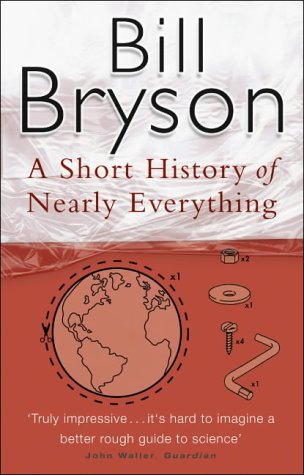
The following extracts are entirely from the amazing book, ‘A Short History of Nearly Everything’ by the brilliant Bill Bryson.
If you’d like to make a Big Bang universe, you need to gather up everything there is – every last mote and particle of matter between here and the edge of creation – and squeeze it into a spot so infinitesimally compact that it has no dimensions at all. This is known as a singularity.
Now get ready for a really big bang! You may wish to retire to a safe space to observe the spectacle but unfortunately there is nowhere to retire to because outside the singularity there is no where. It is natural to think of the singularity as a pregnant dot in a vast, boundless void but there is no space for it to occupy, no place for it to be. We can’t even ask how long it has been there, whether it has been there for ever, quietly awaiting the right moment. Time doesn’t exist; there is no past for it to emerge from.
And so from nothing our universe begins.
When this happened is a matter of debate, the consensus seems to be heading for about 13.7 billion years ago when there came a moment known to science as t = 0.
13 700 000 000 years ago
In a single blinding pulse, a moment of glory much too swift and expansive for any form of words, the singularity assumes heavenly dimensions, space beyond conception.
One ten million trillion trillion trillionth of a second, after the moment of creation, the universe is so small that you would need a microscope to find it.
0. 000 000 000 000 000 000 000 000 000 000 000 000 000 000 1 secs
But then according to inflation theory, the universe underwent a dramatic expansion. Every 10 -34 of that first second, it doubles its size changing it from something you could hold in your hand to something at least 10 million million million million times bigger.
In less than a minute the universe is a million billion miles across and growing fast.
1 000 000 000 000 000 miles across
There is a lot of heat now, about 10 billion degrees of it, enough of it to begin the nuclear reactions that create the elements of hydrogen, helium and lithium. 98% of all matter has been produced and it was all done in about the time it takes to make a sandwich.
Such quantities are of course ungraspable. It is enough to know to know that in a cracking instant we were endowed with a universe that was vast – at least a hundred billion light years across but possibly any size up to infinite – and perfectly arrayed for the creation of stars, galaxies and other complex systems.
100 000 000 000 000 light years
For mankind, the universe goes only as far as light has travelled in the billions of years since the universe was formed. This visible universe – the universe we know and can talk about – is a million million million million miles across.
1000 000 000 000 000 000 000 000 miles across
But according to most theories the universe is much roomier still. The number of light years to the edge of this larger unseen universe would be written not with tens of zeros, not even with hundreds but with millions.
Astronomers these days can do the most amazing things. If someone stuck a match on the moon, they could spot the flare. From the tiniest throbs and wobbles of distant stars, they can infer the size, character and habitability of planets much too remote to be seen – planets so distant that it would take us half a million years in a spaceship to get there.
With their radio telescopes they can capture wisps of radiation so preposterously faint that the total amount of energy collected from outside the solar system by all of them since collecting began (in 1951) is ‘less than the energy of a single snowflake striking the ground.’ (Carl Sagan)
As for our own solar system, none of the maps you would have seen was drawn remotely to scale. It is a necessary deceit to get them all on the same piece of paper.
On a diagram drawn to scale with the Earth reduced to the size of a pea, Jupiter would be about 300 metres away and Pluto would be 2½ kilometers distant (and about the size of a bacterium, so you wouldn’t be able to see it anyway). On the same scale, Proxima Centauri, our nearest star, would be 16 000 kilometres away. Even if you shrank everything down so that Jupiter was as small as the full stop at the end of this sentence, and Pluto was no bigger than a molecule, Pluto would still be over 10 metres away.
The number of probable planets in the universe is as many as ten billion trillion – a number vastly beyond imagining. But what is equally beyond imagining is the amount of space through which they are lightly scattered. If we were randomly inserted into the universe, the chance that you would be on or near a planet would be less than 1 in a billion trillion trillion.
0. 000 000 000 000 000 000 000 000 000 000 001 chance
‘Worlds are precious’
The average distance between stars is over 30 million million kilometres. Even at speeds approaching those of light, these are fantastically challenging distances for any traveling individual. Of course, it is possible that alien beings travel billions of miles to amuse themselves by planting crop circles in Wiltshire or frightening the daylights out of some poor guy in a pickup on a lonely road in Arizona but it does seem unlikely.
A supernova occurs when a giant star bigger than our sun collapses and then spectacularly explodes, releasing in an instant the energy of a hundred billion suns. Most are so far away that they appear no more than the faintest twinkle, occupying a point in space that wasn’t filled before.
Looking for supernovae is mostly a matter of not finding them! Telescopes can now take pictures and let computers detect the telltale bright spots that marked a supernova explosion, but before this technology it was down to the human eye and countless hours of staring at the sky.
The Reverend Bob Evans from Sydney, Australia does this better than anybody else who has tried to spot these moments of celestial farewell.
To understand how good he is, imagine a standard dining-room table covered in a black tablecloth and throwing a handful of salt across it. The scattered grains can be thought of as a galaxy. Now imagine 1 500 more tables like the first one – enough to make a single line 2 miles long – each with a random array of salt across it. Now add one grain of salt to any table and let Bob Evans walk among them. At a glance he will spot it. That grain of salt is the supernova.
…and he has done it 33 times, beating NASA everytime!
A few years ago I was at a ‘Big Noise’ Coldplay concert at Exeter Castle held in aid of Mencap. Dubbed as the homecoming gig and hosted by Jo Whiley, the Radio 1 broadcaster and music journalist, a small lucky audience enjoyed a fantastic night. I was standing next to the presenter for a very brief time and watched how patiently and generously she posed for photos with fans. She struck me as a very warm unpretentious lady, a feeling confirmed a little later when she appeared with sister Francis in a memorable touching moment to introduce the supergroup.
I couldn’t have been the only person that night to have watched ‘Never Mind the Buzzcocks’ Dr Who Special three days earlier and listened to Jo Whiley give a different summation of Coldplay’s talents.
Remind you of being back at school? Well – I suppose if I could earn the type of appearance fees got by appearing on NMTB, HIGNFY and such like, I might default to such scathing congruous behaviour. Historically, the presenters of these two programmes, for example, Simon Amstell, Mark Lamarr, Angus Deayton aided by the likes of Phil Jupitus, Iain Hislop and sadly Bill Bailey for a long while, used to assume the roles of provateurs to generate levity from making targeted guests feel uncomfortable. I think the basic justifications are they know what they’re letting themselves in for and getting good money for it. After all, it’s like sitting in the front row at a comedy gig, you’re asking for it. There are numerous celebrities on Jonathan Ross and Graham Norton who are more deserving of such honesty, instead of the usual sycophantic endorsement, but are sadly sacrosanct. Sir Elton, Sir Terry, Sir Brucie, Sir Cliff, Cher, Arnie, Sly…,Nicki Minaj, Miley Cyrus, One Direction, Justin Bieber….and other smiley beautiful people who have brilliantly uniform perfect teeth, but of course, this is tellyland.
There is however a profession that for pure sociopathic behaviour can eclipse the red carpet brigade and that is journalism. I have two first hand accounts of hard-nosed hacks getting the copy at all costs. Firstly there’s the television crew that visited my wife’s primary school to report on the effect of the impending Iraqi conflict on children with dads serving at the nearby military base. The school’s courageous headmistress, noticing as the day went on that they were going past their remit and trying to get a story that just wasn’t there, – tears on the carpet – , chucked them out at lunchtime. That news team were from the BBC flagship ‘Newsnight’! And secondly the treatment that Joe Church received at the hands of the Daily Express in 1970. when I was 13 and a stage-hand at a seaside summer show of which Joe was the main stand-up comedian. Joe Church was visited by a reporter and photographer doing a feature on the typical ‘end of the pier’ variety show that was popular in those times. The publicity would be very welcome and they spent all day with him. Nobody could have predicted the malevolence of the double page spread article that came out.. He had been duped, cruelly set-up with a photograph of him wearing a red nose and depicted as the sad out of date clown by quoting lines from his act. His fellow entertainers rallied round but you could tell he was a broken man. Humiliated. It left a lasting impression on a young boy how people could be so predatory and vindictive especially to someone who didn’t ask for it or deserve it.
Same with Chris Martin – What do you think, Jo?
Except for the last three words ‘Pass the Salt’ the following extracts are entirely from the amazing book, ‘A Short History of Nearly Everything’ by the brilliant Bill Bryson.
‘Suppose that there was a button you could push and you could light up all the Earth-crossing asteroids larger than 10 metres across, there would be over a hundred million of these objects in the sky.’ In short, you would see not a couple of thousand twinkling stars, but millions upon millions upon millions of nearer, randomly moving objects – ‘all of which are capable of colliding with the Earth. It would be deeply unnerving.’
Well, be unnerved, because it is there. We just can’t see it.
Although it’s only a guess based on the cratering rates on the moon, some two thousand asteroids big enough to imperil civilized existence regularly cross our orbit. A meteor the size of a house could destroy a city and the number of these relative tiddlers in Earth-crossing orbits is almost certainly in the hundreds of thousands and possibly in the millions, and they are nearly impossible to track.
The first one wasn’t spotted until 1991, and that was when it had already gone by. Named 1991BA, it was noticed as it sailed past us at a distance of 170 000 kilometres – in cosmic terms the equivalent of a bullet passing through one’s sleeve without touching the arm. Two years later, another, somewhat larger asteroid missed us by 145 000 kilometres – the closest pass yet recorded and it too was not seen until it had passed and would have arrived without warning.
An object a hundred metres across couldn’t be picked up by any Earth-based telescope until it was within just a few days of us, and that is only if a telescope happened to be trained on it. This is unlikely because the number of people in the world actively searching for asteroids is not much more than the staff of a typical McDonalds restaurant. The first time an unnoticed asteroid would become visible to the naked eye would be when it warmed up when hitting the atmosphere, just about a second before it hit the Earth. You’re talking about something moving many times faster than the fastest bullet.
Here’s a plausible scenario of what it may/will be like if we have an impact of a big asteroid.
a) An asteroid travelling at cosmic speeds entering the Earth’s atmosphere would compress the air causing it to rise to some 60 000 Kelvin or ten times the surface temperature of the sun. At this instant of arrival, everything in the meteor’s path – people, houses, factories cars would crinkle like cellophane in a flame.
b) On impact, the meteorite would vaporize instantly and the blast would blow out 1 000 cubic kilometres of rock, earth and superheated gases. Every living thing that hadn’t been killed by the heat with a range of 250 kilometres would now be killed by the blast.
c) The initial shock wave would travel outwards at the speed of light sweeping everything before it. Within minutes in a surrounding area the size of Northern Europe every standing thing would be flattened or on fire. People up to 1 500 kilometres away would be knocked off their feet and showered with a blizzard of projectiles.
d) The associated damage would be brisk and global. The impact would set off a chain of devastating earthquakes, volcanoes, tsanumis. Within an hour, a cloud of darkness would cover the Earth, burning rock pelting down everywhere setting much of the planet ablaze.
e) It has been estimated that at least one and a half billion people would die by the end of the first day.
And in all likelihood, remember, this would come without warning, out of a clear sky.
– Pass the salt!
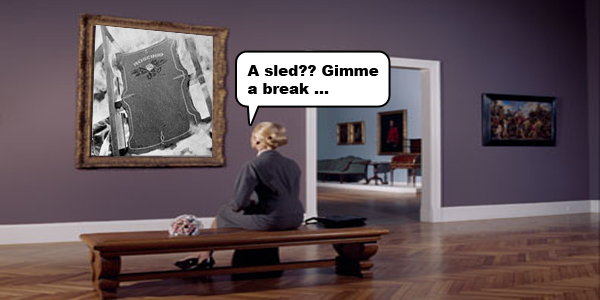
The Anastasia question is a concept I have been thinking about for many years.
Grand Duchess Anastasia, the youngest daughter of the last Russian Tsar, you’ll remember, was executed with her family by the Bolshevik secret police in 1918. Persistent speculation arose, after her death, as to whether she might have survived leading to several women falsely claiming to be Anastasia, of whom Anna Anderson is the best known. Conclusive proof finally confirmed that she was not Anastasia when DNA testing in 1994 on available pieces of Anderson’s tissue and hair showed no relation to the DNA of the imperial family.
This is my question, it’s my game if you like!
What is the one question or fact about yourself that would convince the most incredulous scrutineers that you are in fact who you claim to be. Now you wouldn’t believe how stringent my rules are for this profound secret. In my testing of this ‘Rosebud’ I think of myself as a secret agent being trained over many months to penetrate the network of a fiendishly suspicious and sceptical enemy. Their questioning of who I am is based on them holding every piece of detail of my life and knowing that professional fraudsters can be trained to be completely convincing replicates. This question easily transcends DNA testing. It is absolute. There was and never can be any seepage of this fact between you and the questioner. The Anastasia game of mental solitaire is actually the search for the fact, the question never gets asked! In short, it is what question is the very key to your soul?
Let me give you an example of a near miss for me, lest you think well that’s easily done – just think of something that happened in your childhood.
We have in our kitchen a ramshackle excuse for a crockery set that we everyday try to home on a three-tier small wall shelf system. The cereal bowls, dinner and side plates are all different sizes and colours. The sort of miscellaneous collection you get when you break a piece or two from a set, renew but don’t throw away the existing members. It’s difficult to place each member onto the shelves because there are certain O.C.D. rules to observe. You can’t, for instance, put a bigger plate onto a smaller one or have our favourite mugs, the thin rimmed ones, on the top shelf where you would have to momentarily exert wasteful energy and go on ‘tippy-toes’ to retrieve! Anyway, it works for us and like doing a three-dimensional jigsaw puzzle, I enjoy the swapping and repositioning of the pieces to get them so they fit. The singularly important point in this ‘invisible’ mundane action that nobody else would discern, let alone record, is that the same word always pops into my thoughts when I am in the process of doing it and that is ‘Cravat’. This is interesting solely for me in that there is only one person, (I think!) in the whole universe who would know what the significance of me saying that word in that situation and that is my brother Richard even though we have not uttered this word together for what must be nearly 50 years.
Does this qualify for an Anastasia question? Well since the advent of the internet which makes it clear to us all how individual how unique we are so not, no not necessarily. Thinking in computer-speak, the password security strength of Cravat is compromised by the assumption that nobody else remembers playing Cravat, a card game for two players in which you strive to re-position cards in an array in the minimum number of moves, to which your opponent challenges you with a cry of ‘Cravat’ if he sees a way of doing it with fewer.
– It’s good mind but nowhere near 100% impervious and spy proof.
Happy searching!!
Wars are nearly always for economic reasons and have always provided opportunities before, during and after conflict for commerce, the most recent war in Iraq being no exception.
Not only is it widely recognised that the case for military action against Iraq was based on a pack of lies but also that British and American companies supplied Saddam Hussein arms and gas in the first place.
The 1990 – 2003 financial and trade embargo applied against Iraq by the U.N. had huge humanitarian impacts on the country. What may come as a surprise to some people is that the biggest sanctions busters were in fact American companies allegedly with the full knowledge of their government.
During the actual war itself, billions of dollars of Iraq’s wealth went missing. Oil was shipped out of the country and sold. Federal contracts to supply the military were huge, the biggest $39.5bn being awarded to Halliburton, which was formerly run by Dick Cheney, vice-president to George W. Bush. In fact, the US hired more private companies in Iraq than in any previous war, and at times there were more contractors than military personnel on the ground.
The following quote from a former US Marine general shows that in the modern era it has always been so:
“I helped make Mexico, especially Tampico, safe for American oil interests in 1914. I helped make Cuba and Haiti a decent place for the National City Bank boys to collect revenues in. I helped in the raping of half a dozen Central American Republics for the benefits of Wall Street. The record of racketeering is long. I helped purify Nicaragua for the international banking house of Brown Brothers in 1909-1912. I brought light to the Dominican Republic for American sugar interests in 1916. In China I helped to see to it that Standard Oil went its way unmolested. During those years, I had, as the boys in the back room would say, a swell racket.” (General Smedley Butler, from a speech in 1933.)
Mrs Walker wants to go to Venice this half-term, she says she wants to visit the islands. She needs someone to read her guide book from cover to cover to and seeing all of you are looking at your shoes and making yourselves purposely busy, it looks like it’s down to me again. I don’t read much at all but Mrs Walker does voraciously and I sleep with her. As a consequence of our planned sojourn, she is currently reading about the history of Venice during the Crusades.
Venice has always depended entirely on trade for its survival for obvious reasons. It enjoys a prime stategic position and has had a reputation for being ‘one-eyed’ in its dealing with the empires throughout history. One particular period that illustrates this well is at the end of the 1100s when it was being badly hurt by the embargo brought by the papal ban on trading with the islamic world after the capture of Jerusalem in the 12th century by Saladin. The merchants of Pisa and Genoa had continued to trade so Venice pleaded to Rome for the ban to be lifted to which Pope Innocent gave carefully worded concessions which excluded transaction in any war materials. ‘[We] prohibit you, under strict threat of anathema, to supply the Saracens by selling, giving or bartering, iron, hemp, sharp implements, inflammable materials, arms, galleys, sailing ships, or timbers’
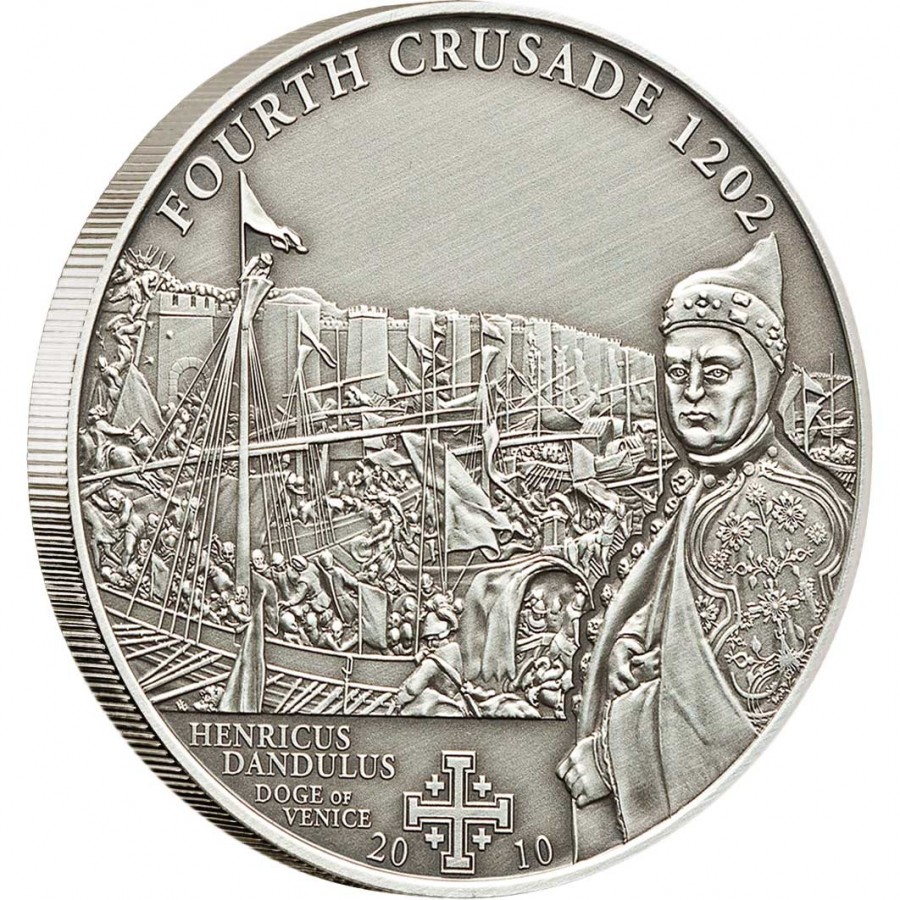
So with trade continuing with the ‘enemy’, Venice also won the tender to supply the Christian military, being the ideal staging port for the 4th Crusade. They built horse transports to carry 4 500 horses and 9 000 squires. 4 500 knights and 20 000 foot soldiers were embarked on the port’s ships. The thoroughness of the Venetian workmen also provided provisions for this navy, both men and horses for nine months.The bill for this was 94 000 marks and they threw in 50 armed galleys, free of charge, as long as this alliance lasted,with the condition that the Venetians receive half of all conquests that the force make by way of territory or money, land or sea.
This committed the Venetians to the largest contract in medieval history.
Now, you tell me what has changed in the last 1 000 years!
 A Monkey in Manhattan